
Pizza Puffs: Magic Trademark? Not So Fast
“Puff the magic dragon lived by the sea.” Words and Music by Peter Yarrow,
Round or square, thin crust or deep dish, New York or Chicago style, red or white, plain or with toppings—most everyone can agree that despite its Old-World origins, Pizza has taken its place beside hot dogs and hamburgers in the pantheon of iconic American dishes. Despite impassioned arguments about which joint makes the best pizza, most aficionados grudgingly embrace one essential truth; there is no bad pizza (well, perhaps pizza with pineapple, but we’ll give that a pass). Thanks to national advertising barrages and smart phone apps, pizza is never far from consumers’ top of mind or fingertips.
One pizzeria that’s captured the imagination of millions thanks to its whimsical slice-chomping Roman caricature and cheerfully redundant “Pizza, Pizza” slogan is Little Caesars:

Consistently ranked among the top chains, Little Caesars stretched its pizza empire by going “Crazy.” Along with its menu of pizza pies, Little Caesars offers breadsticks called “Crazy Bread” and dipping sauce for said sticks called, you guessed it, “Crazy Sauce.”
If Little Caesars had capped its “Crazy” family at two, there would be no trademark story here. But Little Caesars went beyond breadsticks and dipping sauce when it rolled out mini pizza cups called “Crazy Puffs,” describing them as “hand-held Pizza Puffs.”
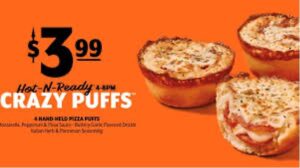
That’s when another company came not to praise Little Caesars, but to bury the new “Puffs;” not with a dagger in the Roman Forum but with a lawsuit for trademark infringement in another forum, a U.S. federal district court.
The Plaintiff, a company called Iltaco, had been using the name “Pizza Puffs” since 1976. Not only had Iltaco chalked up over four decades of prior “Pizza Puffs” use, but it also owned a federal trademark registration for that name. What’s more, the registration had become “incontestable” because Iltaco had continuously used the “Pizza Puffs” name for five years straight. That incontestable status meant that the registration was conclusive evidence of the validity of Iltaco’s “Pizza Puffs” trademark, whittling down Little Caesars’ available invalidity defenses to two: (1) that “pizza puffs” is a generic term, and (2) that Little Caesars had the right to use “pizza puffs” descriptively, also known as the “fair use” defense.
Having poked this “Puff” dragon, Little Caesars set off on a quest to vanquish it with one of the sharpest weapons in a trademark defendant’s quiver—a consumer survey. In this case, it was a survey designed to measure consumers’ general understanding of “pizza puffs.” Do consumers view it as a brand name, like “Hot Pocket” and “Pop Tarts?” Or do they view “pizza puffs” as the ordinary name for a food item, like “calzone” or “cream puff.”
Little Caesars’ survey hit the bullseye; over 80% of people surveyed placed “pizza puffs” in the “generic” basket. That result should have sealed the deal for Little Caesars because generic terms can never be trademarks—they remain free for all to use. And at the very least, the survey should have cemented Little Caesars’ “fair use” defense, the notion that competitors can always use “merely descriptive” terms descriptively if done fairly and in good faith. With over 80% of consumers pegging “pizza puffs” as generic, the district court could have at least treated it as “merely descriptive,” making Little Caesars’ less conspicuous use of the phrase “4 Hand-Held Pizza Puffs” a classic fair use.
But that’s not what happened. The district court judge ruled that Iltaco was likely to prove infringement of “Pizza Puffs” by Little Caesars and issued a preliminary injunction blocking Little Caesar from using “Pizza Puffs” while the case proceeded to trial. (It was only a partial victory for Iltaco; the judge found it unlikely that Iltaco owned trademark rights in “Puffs” per se or that Little Caesars’ “Crazy Puffs” mark infringed Iltaco’s “Pizza Puffs.”)
Little Caesars appealed to the U.S. Court of Appeals for the Seventh Circuit, which reversed the preliminary injunction while affirming the lower court’s decision of non-infringement as to “Crazy Puffs” or “Puffs” standing alone.[1] Little Caesars’s survey results drove the Appeals Court’s decision. The lower court had applied the wrong test, the Appeals Court said. Rather than looking at the “primary significance” of “Pizza Puffs,” the lower court had focused on whether Little Caesars could have used a different term, such as “pizza rolls.” This approach missed the mark. As the Appeals Court noted, the U.S. Supreme Court has made “primary significance” the proper test of genericness. Under that test, a term does not have to be a product’s only generic name if consumers understand it to be one of several generic names for that product.
With over 80% of survey respondents placing “Pizza Puffs” on the “generic” side of the ledger, reversal of the preliminary injunction became a foregone conclusion, leaving Little Caesars free to resume using “Pizza Puffs.” But not necessarily risk free. The lower court’s preliminary injunction ruling, issued early in the case, was not a final decision. Therefore, Iltaco is free to continue pursuing the case to trial on the merits.
For now, however, like Marc Antony praising the fallen Julius, the Seventh Circuit has proclaimed Little Caesars an honorable competitor. (Apologies to Shakespeare.)
“Have it your own way or nothing.” Little Caesar (film, 1931)
[1] Illinois Tamale Co. Inc. v. LC Trademarks Inc. et al., 24-3317; 25-1072; 25-1076 and 25-1112, (7th Cir. 2026)..
Related posts.
Kelly IP Secures Top “Gold” Rankings in 2026 WTR 1000
04 February 2026

Lauren Jancuska Elected as Kelly IP’s Newest Partner
05 January 2026